
It’s been a quiet season for me these last four months. I intentionally stepped back — partly to rest, and partly to listen for what wants to come next in my work and online presence.
Interestingly, one of the clearest insights didn’t come from a website project. It came from selling a guitar that had been with me during a very particular season of my life.
I was in the States recently for an extended stay and decided to buy a Taylor 314ce to keep me company. When I later listed it on Sweetwater, I wrote:
“I bought this guitar to have here in the States while helping my mom through her cancer treatment. It brought me a lot of comfort during a tough time.”
There were three other guitars with almost identical specs — same model, same features. On paper, mine wasn’t especially different. I doubted it would sell.
And yet, four days later, it sold. The buyer’s message said:
“Hi Yael, I was moved by your story and the comfort this guitar brought you. Very beautiful.”
He didn’t choose my guitar because it was technically better. He chose it because of how it made him feel. He chose it because of that short description: me sitting with my mom during a hard time, a guitar quietly keeping me company in between hospital days and treatments.
Without intending to, I had tapped into a core emotion: comfort.
That message has stayed with me, because it mirrors something about how we show up online.
What People Are Really Choosing Online
Every day, people are doing the online equivalent of browsing guitars.
They scroll past websites, Instagram bios, About pages, and offers that, on paper, look almost identical A row of practitioners, educators, coaches, therapists, mentors — many of them thoughtful, experienced, and genuinely good at what they do.
The “specs” are similar. The services overlap. Everyone is qualified.
What makes someone pause on you isn’t the bullet list of techniques or credentials.
It’s the emotion they feel in the first few seconds of meeting you:
- The moment they land on your homepage
- The way your About page speaks to (or misses) their lived experience
- The tone of a short video or a caption
- The feeling they get from your images and words, even before they consciously read everything
Whether we intend it or not, our online presence is already communicating an emotion.
The real question is:
Is it the emotion we mean to be communicating?
Finding Your Core Emotion
The good news: this isn’t hard.
If you’ve been working with clients for a while, your core emotion already lives in the way they talk about you. You can hear it in their emails, in the messages they send after a session, and in the ‘thank yous’ that arrive when something finally clicks.”
Here’s how to start looking.
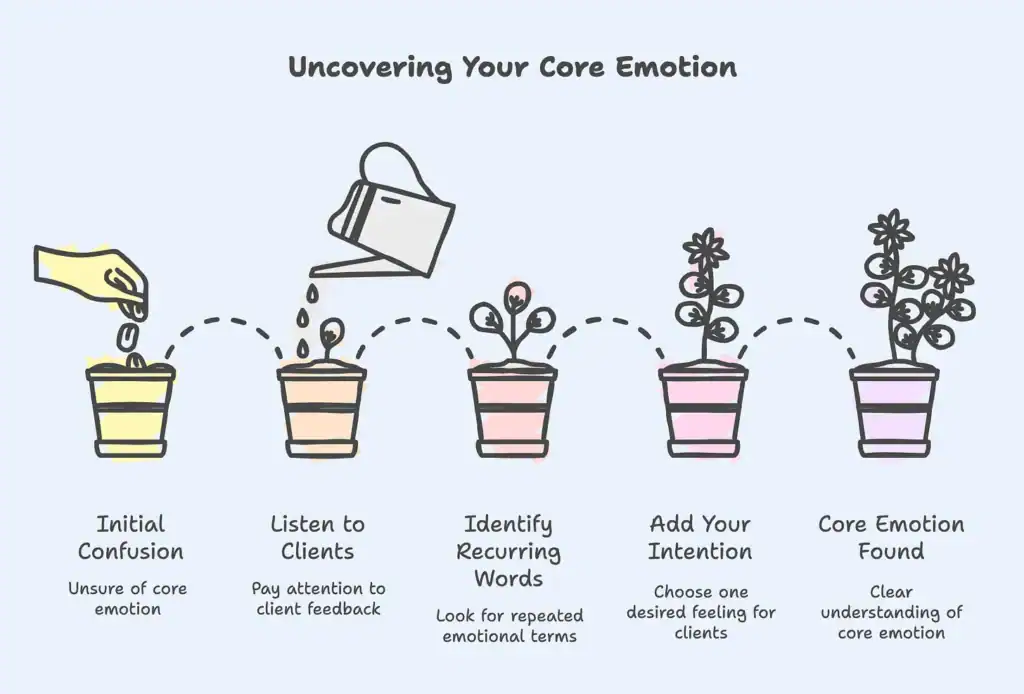
1. Listen to Your Clients
Your clients often name your core emotion without realizing it.
Pay attention to the way they describe how they feel after working with you — in emails, in DMs, in offhand comments at the end of a session, in testimonials on your site.
Notice especially phrases that begin with:
- “I finally feel…”
- “Working with you feels…”
- “For the first time, I feel…”
Then look for the recurring emotional words:
- “I finally feel calm.”
- “I feel seen for the first time.”
- “I feel hopeful again.”
- “I feel lighter.”
- “I feel grounded.”
- “I feel safe naming this out loud.”
- “I feel like I’m not broken.”
Those repeated words are your clues, hinting at your core emotion in the way your clients talk about working with you.
2. Add Your Own Intention
The second lens is your own desire for them.
If someone lands on your website or sees one of your posts, and you could choose just one word for how you want them to feel a few seconds later, what would it be?
- Relief?
- Calm?
- Hopeful?
- Safe?
- Seen?
- Energized?
- Grounded?
- Understood?
- Invited?
You don’t have to get this perfect right away. Choose a word that feels close enough for now, and let yourself refine it as you go.
Between:
- what your clients already say, and
- what you most want them to experience,
a pattern often emerges.
How This Looks at Pixel Happy
For Pixel Happy Studio, the core emotions that guide me are:
Safe and supported
I build websites and brand foundations for soul‑driven practitioners, educators, and consultants — people who are often already holding a lot for others. When they land on my site or step into my process, I don’t want them to feel rushed, overwhelmed, or “sold to.”
I want them to feel held.
That one emotional intention informs and shapes almost everything I do.
Colors & Layout
I use softer, grounded colors and plenty of white space. I want the site to feel like a calm studio or a peaceful office, not a busy, confusing marketplace.
Copy & Language
Phrases like “guided, intentional process,” “from soul to strategy to site,” and “your digital home” are not random. They’re there to say:
You’re not alone. There’s a path. I’ll walk it with you.
Even in more technical pages, I try to keep the tone reassuring and human.
Process & Offerings
The way I’ve structured my foundational workshops — the Hero Statement Workshop and the Clarity Workshop — is about more than strategy. They’re designed as spaces where people feel safe to say, “I’m not clear yet,” and supported while we find the thread together.
How I Communicate
In emails, proposals, and calls, I keep asking myself:
“Is this adding pressure, or adding support?”
That question keeps me anchored in the emotion I want to create.
Different venues — website, emails, workshops, social posts — but the same emotional through‑line.
That’s what makes the whole presence feel coherent, even as offerings evolve or visuals get refreshed.
A Few Questions to Sit With
If you’d like to explore this for your own work, here are a few gentle prompts you can carry into your week:
1. Think of a client you loved working with.
If they finished this sentence after working with you:
“I finally feel ________.”
What word might they use?
2. Look for repeated emotion‑words.
In your emails, testimonials, and conversations, what emotional words or phrases show up again and again?
3. Name a working word.
If someone lands on your site or sees one of your posts, and you could choose just one word to describe how you want them to feel a few seconds later, what word comes up?
You don’t have to overhaul your website or rewrite everything tomorrow. Simply hold that one word up to what you already have and notice what feels aligned and what doesn’t yet.
Over time, that word can become a filter for decisions big and small: headlines, images, colors, even the way you invite people into your work.
Just like that one line in my guitar listing carried comfort through a screen to a stranger, your presence online can carry the emotional heart of your work.
And that’s often what people are really choosing, even if they never quite put it into words.
Thanks for reading.
Warmth and love,
Yael